Sunday, 20 December 2015

How one skeptical scientist came to believe the Shroud of Turin

Shroud of Turin featuring positive (L) and negative (R) digital filters. Credit: Dianelos Georgoudis via Wikimedia Commons.
.- The Shroud of Turin has different meanings for many people: some see it as an object of veneration, others a forgery, still others a medieval curiosity. For one Jewish scientist, however, the evidence has led him to see it as a meeting point between science and faith.
“The Shroud challenges (many people's core beliefs) because there's a strong implication that there is something beyond the basic science going on here,” Barrie Schwortz, one of the leading scientific experts on the Shroud of Turin, told CNA.
Admitting that he did not know whether there was something beyond science at play, he added: “That's not what convinced me: it was the science that convinced me.”
The Shroud of Turin is among the most well-known relics believed to be connected with Christ's Passion. Venerated for centuries by Christians as the burial shroud of Jesus, it has been subject to intense scientific study to ascertain its authenticity, and the origins of the image.
The image on the 14 feet long, three-and-a-half feet wide cloth is stained with the postmortem image of a man – front and back – who has been brutally tortured and crucified.
Schwortz, now a retired technical photographer and frequent lecturer on the shroud, was a member of the 1978 Shroud of Turin Research Project which brought prestigious scientists together to examine the ancient artifact.
As a non-practicing Jew at the time, he was hesitant to be part of the team and skeptical as to the shroud's authenticity – presuming it was nothing more than an elaborate painting. Nonetheless, he was intrigued by the scientific questions raised by the image.  
Despite his reservations, Schwortz recounts being persuaded to remain on the project by a fellow scientist on the team – a NASA imaging specialist, and a Catholic – who jokingly told him: “You don't think God wouldn't want one of his chosen people on our team?”
And Schwortz soon encountered one of the great mysteries of the image that still entrances its examiners to this day.
He explained that a specific instrument used for the project was designed for evaluating x-rays, which allowed the lights and darks of an image to be vertically stretched into space, based on the lights and darks proportionately.
For a normal photograph, the result would be a distorted image: with the shroud, however, the natural, 3-D relief of a human form came through. This means “there’s a correlation between image density – lights and darks on the image – and cloth to body distance.”
“The only way that can happen is by some interaction between cloth and body,” he said. “It can’t be projected. It’s not a photograph – photographs don’t have that kind of information, artworks don’t.”
This evidence led him to believe that the image on the shroud was produced in a way that exceeds the capacities even of modern technology.
“There's no way a medieval forger would have had the knowledge to create something like this, and to do so with a method that we can't figure out today – the most image-oriented era of human history.”
“Think about it: in your pocket, you have a camera, and a computer, connected to each other in one little device,” he said.
“The shroud has become one of the most studied artifacts in human history itself, and modern science doesn’t have an explanation for how those chemical and physical properties can be made.”
While the image on the Shroud of Turin was the most convincing evidence for him, he said it was only a fraction of all the scientific data which points to it being real.
“Really, it's an accumulation of thousands of little tiny bits of evidence that, when put together, are overwhelming in favor of its authenticity.”
Despite the evidence, many skeptics question the evidence without having seen the facts. For this reason, Schwortz launched the website www.shroud.com, which serves as a resource for the scientific data on the Shroud.
Nonetheless, he said, there are many who still question the evidence, many believing it is nothing more than an elaborate medieval painting.
“I think the reason skeptics deny the science is, if they accept any of that, their core beliefs have been dramatically challenged, and they would have to go back and reconfigure who they are and what they believe in,” he said. “It’s much easier to reject it out of hand, and not worry about it. That way they don’t have to confront their own beliefs.”
“I think some people would rather ignore it than be challenged.”
Schwortz emphasized that the science points to the Shroud being the burial cloth belonging to a man, buried according to the Jewish tradition after having been crucified in a way consistent with the Gospel. However, he said it is not proof of the resurrection – and this is where faith comes in.
“It’s a pre-resurrection image, because if it were a post-resurrection image, it would be a living man – not a dead man,” he said, adding that science is unable to test for the sort of images that would be produced by a human body rising from the dead.
“The Shroud is a test of faith, not a test of science. There comes a point with the Shroud where the science stops, and people have to decide for themselves.”
“The answer to faith isn’t going to be a piece of cloth. But, perhaps, the answer to faith is in the eyes and hearts of those who look upon it.”
When it comes to testifying to this meeting point between faith and science, Schwortz is in a unique position: he has never converted to Christianity, but remains a practicing Jew. And this, he says, makes his witness as a scientist all the more credible.
“I think I serve God better this way, in my involvement in the Shroud, by being the last person in the world people would expect to be lecturing on what is, effectively, the ultimate Christian relic.”
“I think God in his infinite wisdom knew better than I did, and he put me there for a reason.”
Interior of the Sagrada Familia.


.- On Wednesday Pope Francis met with members of the organization in charge of promoting the cause for canonization of Antoni Gaudi, known as “God's architect,” telling them that he hopes the cause moves forward quickly.
“The meeting with Pope Francis was an unforgettable experience; he told me that ‘Gaudi is a great mystic’ and that he hopes he will be declared Venerable soon,” Jose Manuel Almuzara told CNA Dec. 18.
Almuzara heads the Association for the Beatification of Antoni Gaudi. Originally started as a small group of laymen with a tiny budget, the association decided to investigate the possibility in of Gaudi's sainthood in 1992; the cause for his canonization was officially opened in Rome in 2003.
In Rome this week for a conference and concert inspired by Gaudi, Almuzara was accompanied by the postulator of Gaudi’s cause for canonization, Silvia Correale, as well as other members of the association.
Titled “Gaudi and mercy,” the event took place the afternoon of Dec. 15 at the Pontifical Institute of Sacred Music. Almuzara was the speaker, and was joined by pianist Manuel José Ruíz Segarra and soprano Rocío Martínez for the concert.
The group met with Pope Francis the next day during his Dec. 16 general audience. During the encounter, Almuzara said that he recited one of Gaudi’s more famous quotes: “The Church does not cease to build and therefore its head is the Pope – which means he builds bridges – churches are bridges to reach Glory.”
He told Francis he appreciates his efforts to “build bridges,” and asked if the pontiff had read a book he had given to him in April titled “Sagrada Familia, Opus Magnum de Gaudí,” to which the Pope replied that he had.
Almuzara explained that the association had wanted to participate in the Jubilee of Mercy in a concrete way, so they came up with the idea of the “Gaudi and mercy” workshop and invited members of universities, dioceses, institutions, schools, parishes from around the world to participate.
When he handed the Pope a flier, Almuzara recalled how Francis said the workshop seemed like “an excellent idea.”
“(Gaudi) is an example of life and work who took mercy into account, with a face to recognize, contemplate and serve; who throughout his life lived with intensity the signs of the presence and the closeness of God,” Almuzara said.
The audience with the Pope, then, was a means of uniting with his desire to make the Church “a credible sign of mercy,” he said, adding that “we believe that Antoni Gaudi is an example through his life and work.”
Gaudi, a Servant of God, was born in 1852 in Spain's autonomous community of Catalonia. He was a devout Catholic, which together with forms drawn from nature greatly influenced his architecture; he has received the nickname “God’s architect” due to the emphasis he placed on religion in his works.
His most famous work is the basilica of the Sagrada Familia (Holy Family) in Barcelona. He began his work on the masterpiece in 1883, and in 1914 stopped all other projects to work exclusively on the masterpiece, to which he dedicated himself until his death in 1926.
The church was consecrated by Benedict XVI in 2010, and named a basilica. Still under construction, it is expected to be completed by 2026, to coincide with the 100th anniversary of Gaudí’s death.
The basilica is known to have inspired conversions, one of whom was a Japanese architect who in 1998 was sent by the South Korean government to study Gaudi's work in Barcelona, in preparation for an exhibition on the Gaudi’s works.
Given only one week to complete his work, the man, a Buddhist at the time, wrote a letter to the association several months later revealing that he was converting to Catholicism.
That same Japanese architect designed a special ambo for Florence’s Cathedral of Santa Maria del Fiore, which was completed and installed in time for Francis’ Nov. 10 visit to the Italian city. (Almuzara told us this during the Pope’s visit to Florence – we tried to track the architect down, but were never able to reach him.)
Almuzara and Correale also had a meeting with Cardinal Angelo Amato, Prefect of the Congregation of the Causes of Saints, and the congregation’s secretary Archbishop Marcello Bartolucci, in order to discuss the progress of Gaudi’s cause.
The meeting was “very cordial and helpful,” Almuzara said, adding that while no dates have been set, the cardinal encouraged them to continue working to advance the cause.
Specifically, the cardinal encouraged them in their work compiling what is called the “la positio super vita, virtutibus et fama sanctitatis,” that is, the book compiling “the position on the life, virtues and reputation of holiness” of the person under question.
Included in “the positio” are several things, which Almuzara listed as: a full exposition on the history of the cause or process; the declarations of the witnesses and the documentation on the person’s life, work and the reputation of holiness of the person’s intercession; the opinion on the person’s writings; the documented biography of the person and the information on the heroic virtues they exercised.
Once the volume is completed it must be presented to the congregation, Almuzara said, explaining that if they recognize the heroic virtue of Gaudi, it will then be presented to the Pope, who would then authorize it’s publication, allowing Gaudi to be called “Venerable.”
He also spoke of possible miracles attributed to Gaudi, saying that while there is “no miracle recognized as such” yet, certain favors have been recorded by individuals and families who have asked for Gaudi’s intercession and sent them in for study.
As of now “there is no concrete date for Gaudi to be either a venerable or a blessed,” Almuzara said, but added “who can calculate or put a date on a miracle?”
The miracle, he said, “we put in into the hands of Divine Providence, (because) only God knows the day and the hour.”
“Therefore we remain vigilant,” he said, and, quoting a remark Gaudi had made about the amount of time needed to complete the Sagrada Familia, stressed that “our client is not in a hurry.”

Friday, 18 December 2015

We contemplate God's mercy in the Nativity scene – Pope Francis

.- Pope Francis greeted the donors of the Christmas tree and the Nativity scene in St. Peter's Square on Friday, recalling that Christ's birth in the manger shows that he never imposes himself upon us.
“He makes himself small, he becomes a child, to attract us with love, to touch our hearts with his humble goodness,” Pope Francis reflected Dec. 18 at the Vatican's Paul VI Hall.
“I give you my cordial welcome and thank you for the gift which you have prepared. They are very beautiful; and it gives me joy to think that they are not presented only to the Pope and to the pilgrims who will admire them, but above all to the Lord Jesus: for it is he whom we are celebrating!”
Pope Francis met with faithful from the Bavarian towns of Hirschau, Schnaittenbach, and Freudenberg, all in the Regensburg diocese, who donated the 105 foot Christmas tree adorning St. Peter's Square; and with the faithful of the Trento archdiocese, who donated the Nativity. He thanked by name Bishop Rudolf Voderholzer of Regensburg and Archbishop Luigi Bressan of Trent for their “courteous intentions and help” in the projects.
The Christmas tree was decorated by children suffering from cancer, who made designs based on their dreams and wishes. Pope Francis commented, “I would also like to thank the young 'artists' who have decorated the tree, and to congratulate them: you are still very young, but already your work is shown in St. Peter's Square! And it is beautiful. Have courage, go forward! Michelangelo began thus!”
He reflected that the children's desires “are now in the most suitable place, because they are close to the child of Bethlehem: they are entrusted to him, who came to live in our midst. Indeed, Jesus did not simply appear on earth, and did not dedicate just a little of his time to us, but rather came to share our life and to receive our desires, as he wanted and still wants to live here, along with us and for us. Our world, which at Christmas became his world, is important to him. The creche reminds us of this: God, in his great mercy, descended to us to stay with us.”
Pope Francis said the creche reminds us that Christ “is never imposed by force. Remember this well, you children and young people: the Lord never imposes upon us with force. To save us, he did not change history by performing a grandiose miracle. Rather he lived with simplicity, humility, meekness.”
“God does not like the dramatic revolutions of the powerful of history, and does not use a magic wand to change situations,” the Pope said. “Instead he makes himself small, he becomes a child, to attract us with love, to touch our hearts with his humble goodness, to draw attention through his poverty to those who worry about accumulating the false treasures of this world.”
Recalling that it was St. Francis of Assisi who began the tradition of setting up Nativity scenes, Pope Francis quoted the “Franciscan Sources,” which say the saint wished in doing so to “in some sense glimpse with the eyes of the body the hardships in which he lacked what is necessary for a newborn” and that in creches “we honor simplicity, exalt poverty, praise humility.”
“I invite you, then,” Pope Francis said, “to pause before the Nativity scene, for there God's tenderness speaks to us. There we contemplate divine mercy, made flesh so that we gaze tenderly upon it.”
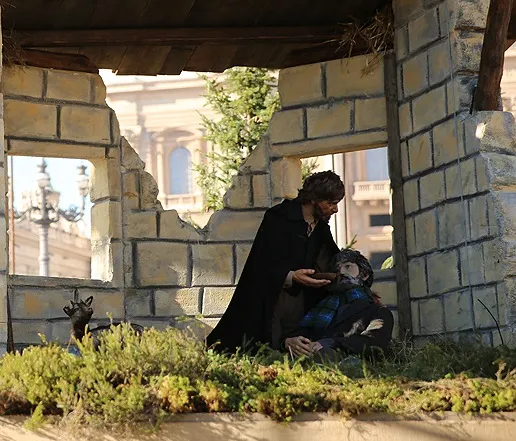
“Above all, however, he wishes to move our hearts. It is beautiful that there is present in this creche a figure who immediately grasps the mystery of Christmas.”
"It is a person who performs a good act, stooping to assist an elderly person. He not only looks to God but also imitates him, as, like God, he inclines mercifully to one in need."
Pope Francis concluded: "May these gifts of yours, which will be lit up this evening, attract the gaze of many and above all revive in our life the true light of Christmas."